Saturday, June 13, 2009

an orange winter

As a native Midwesterner, it seems impossible to me that here in Carmen Pampa we are nearly one week away from the official beginning of winter.  Yes, it's "cold"--at least by Yungeño standards (which I've now adapted to be my own).  But as soon as I catch myself complaining of "freezing" temperatures here, I can't help but think that this would still be considered shorts and sandals weather in Minnesota. 

One of many bags of oranges and mandarines that can be found in the volunteer house. While a glass of fresh squeezed juice in the U.S. might cost $2-3 a glass, here at home it costs us just the physical labor of squeezing.

It's also bizarre to me that as the temps drop the amount of fresh citrus in our house has spiked.  Within the past four days we've had a couple local community members bring giant bags of oranges and mandarines, picked fresh from their trees, right to our door. You just can't beat free, front-door service!

In the U.S. I rarely buy oranges--fearful of biting into a dry, tasteless fruit, I prefer not to take the risk (or pay the price!).  But here, while the citrus sometimes doesn't look all that great on the outside, the inside is almost guaranteed perfection--juicy and sweet!  In one sitting, we can easily eat 2 -3 oranges as dessert or a snack.

Which, considering the multiple pounds of citrus that we now have in our house, that's a good thing.  We shouldn't have any problem eating our way through the mountain of fruit--especially considering Andy's "mandatory quota" that each person in the Volunteer House must eat "at least ten oranges per day." By my calculations, considering the that there are five of us in the house and assuming no more people come bearing bags full of fruit, we should be out of oranges by the first part of July!

Winter, it seems, is a lot more tolerable with the presence of unlimited access to Vitamin C!

Thursday, June 11, 2009

corpus christi

Twelve years of Catholic school education and my response when I heard about Corpus Christi was, "Huh? Like the city in Texas?"

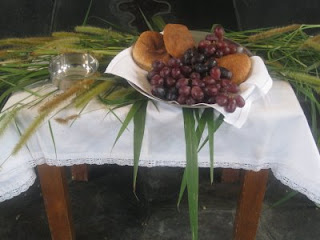
Bread and grapes were set at the altar for the all-school mass this morning. Corpus Christi is a celebration of the Eucharist.

To be fair, when I pressed students for the reason behind the festival that is recognized as a national Bolivian holiday, nobody could really give me a good explanation. "We spend the day at home with our family," one professor told me. "The tradition is to eat peanuts and fruit," a student said.

"Okay," I accepted the family, fruit, and nuts explanation. "But what IS it?" I pressed.

Everyone told me that it is a Catholic feast day...which, with a name like Corpus Christi, I think that is pretty obvious. I just couldn't understand why it isn't a big-deal holiday in the U.S., let alone a day I remember celebrating at church.

Male faculty and staff from Campus Leahy faced off against their counterparts from Campus Manning.  Manning put the smack down on Leahy...with help from our very own Andy Engel who had a goal!

A search on Wikipedia explained that it is a feast day which celebrates the Eucharist, the body of Christ.  While in the U.S. we always celebrate it on Sunday (which is what threw me for the loop), here in Bolivia, Corpus Christi is recognized as the first Thursday following Trinity Sunday...and it comes complete with a whole day off from work.

Today at the College, in honor of Corpus Christi, all classes are suspended.  An all-school mass was held this morning followed by games (basketball, futsal, and soccer) between administrators, professors, and students.  At 2pm everyone gathered in the patio on Campus Manning to have lunch and conversation.  This afternoon games continue.  So this confirmed the part about spending time with family/friends.  But I'm still not sure where the fruit and nuts fit in!?

I know for sure if we celebrated Corpus Chrisit this way in the U.S. I would've known that this feast day is about a whole lot more than some city in Texas.

Tuesday, June 9, 2009

privacidad

On Sunday afternoon Hugh and I got a whirlwind tour of about four different government hospitals that are all clustered together in the Mira Flores neighborhood of Bolivia's capital city, La Paz.

Lic. Lidia Cuevas, Director of the UAC-CP's Nursing Department, invited us to accompany her and UAC-CP Nursing instructor, Lic. Maria Luisa Rodriguez, on a brief tour of the hospitals so that we could see our Nursing students in their element.  Not wanting to cause disruptions (as our students were officially on-duty), we briefly said our hellos, snapped pictures, and went on our way.

UAC-CP Nursing students check the vitals of a baby in the neonatal section.

But between the children's hospital and our final stop at the intensive care unit, I couldn't help but feel a little awkward. Though we weren't entirely random and Lic. Maria Luisa served as our guide, I felt a bit intrusive.
 
The big, institutional space provided nothing in the way of privacy. In one area, makeshift "rooms" were made of curtains that separated every two beds. In another part, 20 single beds all lined up against the wall, filled a room. With no walls or dividers, conversations and physical consultations were for all to hear and see. If privacy laws exist, they are definitely not enforced.

UAC-CP Nursing instructor, Lic. Maria Luisa helps one of our students insert an IV into a patients arm.

As Hugh and I walked through areas of the hospital compound that I'm not convinced we should've been allowed to enter, I realized how much we, in the U.S., take our privacy for granted. For us,  it's a right we've come to expect, for Bolivians it's a seemingly foreign concept--personal space and privacy are essentially not recognized.

This is especially true in the countryside. Our students, for example, come from homes where often their entire family of 5 - 6 people lives in one or two rooms; beds are commonly shared by at least two siblings (when I've stayed with UAC-CP families, they've slept three to a bed to accommodate me with my own place to slumber). Here at the College, our students live 20 to a room; bathrooms, showers, everything is shared.  

The same is also true for health care. I clearly remember a trip to a local community with the UAC-CP doctor.  I overheard each patient describe their symptoms; I saw people give urine samples in the corner of the room; I saw shirts pulled up and pants pulled down...and all their neighbors saw and heard the same thing.  It's no wonder Bolivians often say: "Pueblo pequeño, infierno grande."  (Little town, big hell) Private lives are hard to keep and gossip is a popular alternative for those without televisions.

Though the majority of UAC-CP Nursing majors are women, there are a handful of men who choose the profession.

I believe there is a sense of dignity that comes with having access to privacy--knowing that your business is your own; that it is for you to decide with whom you want to share it, assuming, of course, that you want to share it. 

Hopefully that's part of the training our Nursing students receive--the ability to treat people with tender care and attention...and with concern for their privacy.  In this way, the sick can at least know the feelings of security and peacefulness...that is privacidad.