Friday, December 12, 2008

going the distance

You can't quite fully comprehend the miracle of the UAC-CP until you see where our students come from, until you experience the way they live and understand the great distances they go (both literally and figuratively) to be educated.

It took us one hour driving and one hour walking to reach this UAC-CP student's home outside the community of Juan Agua.

When I hear students matter-of-factly recall the multiple hours they walked to attend grade school and high school; when I hear their parents tell me that they themselves can't read or write because they never had the opportunity to study; when I visit their homes and see that they grew up--not only without books, but without electricity and running water (and so many other things that I consider basic necessities), I can't help but think that it seems quite improbable that many of our students would have ever graduated from high school, let alone college.

And yet, they do graduate from college. In fact, one young man just did this morning.

As I explained in my last post, I recently traveled to the faraway town of Apolo with UAC-CP student Edwin Zapata.* Together, Edwin and I spent three days visiting families of our students who live in and around the town of Apolo. We traveled by public mobility, private taxi, and on foot. We traveled down roads, across rivers, and over bridges that, at the time, all seemed impassable. We traveled, by my estimation, an average of 10 hours each day--locating families that live, by their estimation, up to 5 or 6 hours away from the town of Apolo...by foot.

Edwin walking in the countryside on our way to visit a family of a UAC-CP student.

We arrived at each home unannounced, but always welcomed (and always sent on our way with homegrown gifts: bread, bananas, beans, eggs, mangoes, etc). Invited into their one or two-room homes, I sat poised with a notebook and pen, a handheld voice recorder at my side, and Edwin nearby to serve as my Quechua interpreter.** And I listened as mothers and fathers explained why they believe education is the key to transforming their lives.

Every student at the UAC-CP has a story. In the coming days I hope to share some of the stories they shared with me during my visit to Apolo.


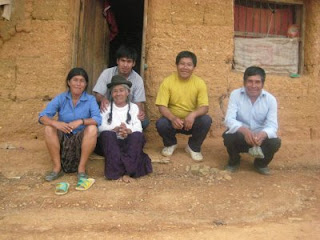
I visited the house of UAC-CP Education student David Paredes. I was welcomed by (L to R) one of his older sisters, David's niece, his mother, Maria, his nephew, and his brother-in-law.
------------------------------
*Apolo is located so far away from the College, in fact, that by my calculations it actually takes me less time to travel between Carmen Pampa and Minneapolis than it does for students to travel back to their homes in Apolo--which explains why they seldom go home.

**The majority of people, primarily older people, in this area of Bolivia speak only Quechua, the indigenous language spoken by the Incans.

Thursday, December 11, 2008

apolo, apolo...te doy mi corazón

This morning I returned from a six-day journey that took me to the Bolivian towns and villages that generally aren't worth mentioning--in the guidebooks, at least.  

The idea was hatched about two months ago when 24-year-old Edwin Zapata, an Agronomy thesis student, invited me to go with him to visit his hometown of Apolo--Bolivia's version of cowboy country northeast of La Paz.  I gladly accepted his offer as it presented me with the opportunity to meet UAC-CP students' families and catch up with graduates and thesis students in a part of Bolivia that I had yet to experience.


Edwin and I started our journey together early Saturday morning in La Paz.  Our bus, filled primarily with jovial Apoleños headed back to their hometown to celebrate the town's annual festival on December 8th, left the city promptly at 7am.   As we made our way across the brown, barren altiplano, passing the infamous Lago Titicaca, the woman across the aisle cried out what was to be the first of many hometown anthems: Apolo, Apolo...te doy mi corazón! (Apolo, Apolo...I give you my heart!)

By noon, the sun had made way for cold, misty weather and I woke up from a nap to see alpacas grazing the rocky countryside, fearlessly walking across the road in front of our bus.  

After a brief bathroom stop in Charazani (elevation 10,000 feet, mas o menos) the road started to drop and we entered greener and, more importantly, warmer, territory.  Edwin, ever the agronomist, was quick to point out plants, animals, and points of interest along the way. From the window, he took pictures of waterfalls and the mountain scenery.

A photo Edwin snapped from the window of the bus--about 4 hours away from Apolo and about 45 minutes before our flat tire.

Originally, he had told me that Apolo was about 12 hours from La Paz by bus.  But, due to some technical glitches (i.e. flat tire and no gas) and the fact that the bus moved at, according to Edwin, "a turtle's pace," we didn't arrive to the main plaza until 10:30pm--more than 15 hours after leaving Bolivia's capital city.  

Anxious to be off the bus, we gathered our things, exited the flota, and walked to the outskirts of town.  In the dark, we made our way to Edwin's family's house where his parents, worried that we had not arrived sooner, anxiously awaited our arrival.

Immediately, I felt welcomed and at home in their casa.  Edwin's mom quickly made us something to eat--she fried up yucca and the UAC-CP smoked sausages that had survived the journey with us to Apolo.  By the light of a lone light bulb that dangled from the ceiling of what was to be my bedroom for the next three days, the four of us sat and talked--primarily about education.  Because neither of his parents have had the opportunity to visit the College, they asked about their son's studies.

Edwin pictured on Sunday morning with (from L to R) his mother, paternal grandmother, uncle, and father.

"You told them, right?" I asked Edwin.  "About yesterday?"  Edwin shook his head no and I gave him a disgruntled look that prodded him to share his exciting news.  Sheepishly, he admitted that the day before he had defended his thesis pre-defense, one of the final steps to officially graduating from the UAC-CP.  His parents beamed; they immediately wanted to know when he would graduate.  Probably February or March, Edwin told them.

"We never thought a poor family like us," Edwin's dad said, "would have a son who would graduate from college."  Edwin's mother said she just couldn't believe it.

"Well, believe it," I said, smiling at Edwin as he washed down his yucca with a glass full of guarapo, the traditional Apoleño sugar cane drink.  "The next time he comes home to Apolo, he'll be Ingenerio Edwin Zapata."

Thursday, December 4, 2008

la cooperativa

The other day I was invited to eat lunch with students at the Virgen del Carmen Cooperativa--one of three food cooperatives at the College.  What originally started as a small group of UAC-CP students pooling together what little money the had to be able to eat, has since turned into the College's primary cafeteria system.  Today, most UAC-CP students are socios, or members, of the food cooperatives.

A typical meal at the cooperatives:  a bowl full of rice, potato, lettuce, platano, and meat.

Though it had been a while since I had eaten lunch there, I am no stranger to the co-ops.  When I worked as an administrator at the College in 2004 and 2005 one of my primary responsibilities was to manage the cooperatives.

I worked with groups of students, elected by their peers, to manage each of the co-ops.  The governing board makes and enforces the rules, decides turns for cooking, cleaning, and grocery shopping, and manages all the finances.  They also make sure that all members have paid their monthly dues--a difficult task considering students often don't have the money.

Lunch with Jeronimo Payhuanca and Gladys Rivera (the picture taker) at the Cooperativa Virgen del Carmen.

Thanks to the generosity of the Roach Family's gift to the Carmen Pampa Fund, the College is able to subsidize the cost of the food coop.  Though it actually costs about $30 for a student to eat at he co-op (this covers food, salaries, kitchen utensils/appliances, and building upkeep), UAC-CP students each pay approximately $20 per month.  Still, for some students, this cost is prohibitive.  Many look for work off campus or receive help from their parents.

Though the primary function of the co-ops is to ensure that students have three regular meals to eat each day, there are other benefits, too.  For one, students learn (often difficult) lessons about working together as a team.  They also gain valuable leadership experience--I've watched shy, introverted first-year students transform into confident, respected leaders.

That said, the coops are by no means problem-free; it's a lot of work to organize college students to feed nearly 300 people three times a day.  But on the day I visited, as students went out of their way to make sure that I had a bowl full of food and mug full of jugo, I couldn't help but notice the good things about the co-ops--like the camaraderie of sitting together and sharing a meal.