Saturday, June 6, 2009

jornada scientífica

Yesterday afternoon the UAC-CP's Research Institute hosted its bi-annual jornada scientífica--a public, science exposition of student research projects. 

Groups representing all five of the College's academic departments (Nursing, Agronomy, Veterinary Medicine, Ecotourism, and Education) presented various investigative work they had done during the past semester.

Fr. Freddy stands with Agronomy students waiting to present their research findings to the judges.

Before the four invited judges started evaluating each group's work, Fr. Freddy, Director of the UAC-CP, spoke to the student body about the importance of research.  He said that the Research Institute is a core component of the College; it works to fulfill the vision of the Unidad to create change and development; and to provide answers and solutions that lift people out of poverty. 

A Nursing student explains the results of an experiement in which she and a classmate determined that by using the roots of the Motacue tree, commonly found in the Alto Beni (and, I learned, some parts of Carmen Pampa), one can effectively treat certain human parasites.

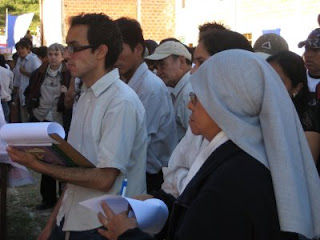
A crowd gathers behind two of the judges to listen to students explain their research project.  Approximately 20 groups of 2-5 students each shared their investigative work.

Some Ecotourism students did a study to determine the effects of tourism on the natural environment.

Thursday, June 4, 2009

gladys

As difficult as it is to believe, the calendar doesn't lie.  Already it has been a little more than four years since I set out on a solo journey to find a handful of UAC-CP students with USAID scholarships who live in scattered and remote communities in Bolivia's Alto Beni.

Some of our students live in places that aren't accessible by road. In 2005 Gladys Jahuira and I took a boat on the La Paz River in the Alto Beni in order to arrive at a UAC family's home.

My mission was to visit their homes, meet their parents and assess their living situations (family income, standard of living, etc.).  In the end, apart from accomplishing my mission, I came home to Carmen Pampa humbled and inspired. To understand our students, I realized, one must know the places they call home.

One of the names on my list that January was Gladys Jahuira--a shy young woman who had just completed her first year at the College.  Just as I was trying to figure out how I would even begin to locate her family's remote, rural home, I fortuetously ran into Gladys on the street (she happened to be in Palos Blancos for the weekly market).  So together, she and I made our way to her family's casa where I met her parents and siblings.  

The memory of the conversation that ensued is so clearly etched into my mind. In my report for USAID, I wrote: "Through tears, first-year Agronomy student Gladys Jahuira's father told me that he is extremely proud of his daughter."

In January 2005, I took this picture of Gladys (center) with her parents and three siblings outside their home.

On my visit to Palos Blancos last weekend, I once again randomly met Gladys on market day. Finished with all of her coursework at the College as of last semester, she is now living at her parents' home outside the village of Sapecho. She plans to begin her thesis research project in a few weeks with SIEMPRE-FORJA (a nearby bio-pesticide research and production company owned by UAC-CP graduates). Meanwhile, she's working with a cacao cooperative in her community of which her parents are members. She organizes local farmers who grow cacao for Bolivia's well-known chocolate company, CEIBO. Things are going well, she explained; based on her work she has been offered a part-time job managing the cooperative's finances. 

This past Saturday, with Gladys voluntarily at my side for visits and interviews, I kept having flashbacks--I couldn't help but think about the young woman from four years ago compared to the Glayds Jahuira I know today.

On the streets of Palos Blancos, Gladys ran into a member of the cacao cooperative she manages.

Four years ago, Gladys Jahuira was shy and reserved; she guarded her emotions and thoughts. She said very little. 

But not the Gladys Jahuira I know today. She's a pretty serious young woman who radiates confidence and maturity that is so unlike most of her female peers who live in the rural area. She isn't an overt talker, but these days Gladys easily makes conversation--sitting in the plaza, she and I discussed politics, cultural differences, and women's rights. She's ambitious; she's a visionary. She holds her own...and then some.

Lunch with UAC-CP graduates Fortunato Velasquez and Andres Florez and UAC-CP thesis student Daniel Criales (center left) in Palos Blancos. Gladys will be doing her thesis research with their local business SIEMPRE-FORJA.

Twice during the day we ran into men who were members of the cacao cooperative she's managing.  "Don Emilio," she told one man as we sat in the backseat of his taxi, "the cacao you brought me is not good quality." Gladys insisted he bring a different batch.  He gave her a wise, flirty retort and stepped out of the taxi for a moment. Gladys looked at me and rolled her eyes. "Machismo," she said, "But I know, he will bring a different batch of cacao."

I can only imagine that the way I feel about witnessing the metamorphosis that Gladys has undergone since her time at the UAC-CP is something similar to the way parents feel watching their children grow and mature. It's exciting to see how she's blossomed into a self-assured woman.

"Do you know what's different about me, I think?" she asked  as we talked about the traditional roles of women in Bolivia's rural area.  "I don't feel lost in life; I know what I want." And she's made the decisions and sacrifices to make it all happen. I'm curious to know where she'll be in another four years.

Monday, June 1, 2009

salud pública

Tonight I returned from a brief three-day visit to the Bolivian lowland towns of Palos Blancos and Caranavi--located seven and four hours, respectively, from Carmen Pampa. 

Sign along the side of the gravel road in Palos Blancos indicates the hospital is 100 meters to the right.

The pueblos are, for reasons quite obvious to me, not tourist destinations (Caranavi, though barely mentioned in the Lonely Planet travel guide, is accompanied by the words "uninspiring" and "stuck here"--which, to be fair, is more mention than Palos Blancos receives). Needless to say, this trip was straight-up UAC-related; my main objective was to visit UAC-CP Nursing students who are doing their required public health practicums. 

Nursing students Alcira Pacajes, a native of Caranavi, and Vilma Callizaya, from Coroico, work at the hospital in Palos Blancos as part of their public health course.

In Palos Blancos, I met with fourth-year Nursing student Alcira Pacajes and third-year Nursing student, Vilma Callizaya.  On-call 24 hours a day, 7 days a week (in exchange for basic housing and food), the women had to ask for special permission to spend a few hours talking with me about their work in Palos.

Because Palos Blancos is a bit short on professional staff, both women have a variety of responsibilities.  They work in PAI (Amplified Immunization Program), DOTS (the World Health Organization's Stop TB strategy), and the hospital's sparsely equipped emergency room. Part of their public health responsibilities also requires them to give talks in local schools, participate in community health fairs, and visit homes in the countryside.

Compared to their experiences in hospitals in La Paz, both Alcira and Vilma said that they see much more need in the rural area for adequate access to health care and education.  They also said they see more incidence of accidents and disease. "Many people in the rural area do not trust modern medicine...and for that reason, people--especially pregnant women and children--die or become severely ill," Alcira said. Educating the public, often in their native Aymara, is one of their primary jobs.

Posters about Dengue Fever were plastered all over both hospitals in Palos Blancos and Caranavi. Dengue, transmitted by mosquitos, presented a severe epidemic in Bolivia's lowlands this past January and February. Some of our students are currently recovering from Dengue.

Though there are six UAC-CP Nursing students currently working as interns at the Caranavi Hospital (all of whom are responsible for paying for their own food and housing), I spent most of my time with third-year Nursing students Rosa Sejas and Gabriela Mamani. They work in the hospital's DOTS program that provides outpatient care to people with tuberculosis.

Gabriela Mamani stands next to an information panel outside the Caranavi hospital that explains how people can be tested for TB and the way the disease is transmitted.

"There is a very high incidence of tuberculosis here in Caranavi," 24-year-old Rosa said. Her classmate Gabriela explained that it is mainly attributed to poor nutrition--diets generally consist of very little meat/protein. 

"Because of the economic situation [ie. incidence of poverty], people here mostly eat a lot of rice, yucca, and plantain," Gabriela said.  She also said that unhygienic living conditions, high levels of stress, and inaccessibility to health care all contribute to the higher rate of tuberculosis in this area.  In Caranavi, she admitted, it's easy to understand why tuberculosis is referred to as the poor person's disease.

It's easy to identify our UAC-CP Nursing students--as demonstrated by this pocket protector.

All the students I met with agreed that while the health-related problems facing people in Bolivia's rural area are overwhelming, change is happening. Talking to our Nursing students I felt quite confident that they are part of this change.

Gabriela, who comes from the Isla del Sol--an island in Lake Titicaca located three hours by boat to the town of Copacabana--said public health practicums like the one she's doing in Caranavi will make her a better nurse.  "I hope to return to my community once I graduate," she said. "Right now there isn't much in the way of health care." In times of emergency, people must go to Copacabana.  And for emergencies that occur at night, people must wait until the morning. But often, people can't wait until the morning. "Many people die from things that they shouldn't have to die from," Gabriela said. "Maybe I can help make a difference; that is why I want to be a nurse."